What I Learned from Helping Introverts Master Public Speaking — Salvatore Manzi
Communicate Like a Leader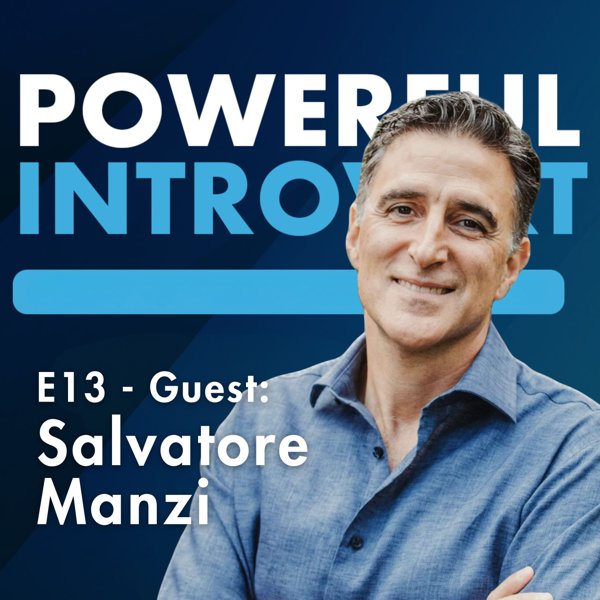
Salvatore Manzi is an introvert who became a leadership communications coach after his father's example of public speaking scared him into trying it — and he spent the next 20 years building the frameworks he wished had existed for quieter, data-driven leaders. His central argument is that presence is not a personality trait; it is a physical practice that can be trained through breath, posture, space-taking, and the disciplined use of the pause. For introverted leaders, this episode is one of the most technically specific in the series — a toolkit, not just a philosophy.
The longer I wait to speak, the more pressure builds — the more gravitas I need to bring to that one comment.
Presence determines influence.
People can't listen until they feel heard.
Not about me, not about me, not about me — I'll say it ten times before a contentious conversation.
Key Stories
- Public speaking as “turning my body on fire”: Salvatore opens by describing how terrifying it was, then explains that the fear itself was the reason he committed — he needed to conquer his greatest fear, and kept getting back on stage until he did.
- Stand-up comedy class as research: As a communications professional, Salvatore took a stand-up comedy class to experience the highest-stakes version of public speaking. His first set went well because he prepared for a specific audience; his second bombed because he didn’t adapt. The lesson: prepare but never follow a script, and know your audience.
- Greg’s deadpan humor as a meeting entry strategy: Greg shares that he breaks the seal in meetings with deadpan humor — “plausible deniability if no one laughs” — and Salvatore validates that introverts’ heightened attunement to room dynamics makes them better at reading the moment for this than extroverts.
Techniques & Frameworks
- Break the seal early: Speak within the first five minutes of any meeting — even a small, simple contribution — to release the building pressure that makes the longer you wait, the more gravity your eventual comment must carry.
- The anticipatory pause: Pause not at commas or periods, but mid-sentence — so the room knows more is coming. This holds attention rather than inviting interruption. Three to five seconds of pause reads as intentional; one to two seconds reads as forgetting your place.
- Space, silence, stillness: The three physical markers of presence. Take up space (elbows away from body), move with stillness (graceful, intentional gestures), and hold silence comfortably. Move 5% slower than everyone else in the room.
- The exhale technique: Calm physiological arousal not by inhaling deeply (which opens the rib cage and speeds the heart) but by taking a slow, long exhale and holding the chest cavity closed after — a counterintuitive but research-supported technique.
- You then me: When triggered by anger or agitation, begin by voicing your understanding of the other person’s world — their hopes, fears, and context — before asserting your own position. Forces empathy and often dissolves the conflict before escalation.
- 54-3-2-1 grounding: Five things you can see, four you can hear, three you can touch, two you can smell, one you can taste. Interrupts perseveration and restores present-moment awareness.
- Reframe the rush: Relabel the adrenaline surge before speaking as excitement rather than fear. The physiological experience is identical; the interpretation changes the outcome.
- People want a dialogue, not a download: Stop presenting the whole buffet. Take the order. Bring one dish at a time. Senior leaders want to engage your thinking, not audit your data.
Full transcript
It’s tax time y’all, if you want to file free, this next one’s for you. Love that jam. Up next, commercial! Into it, TurboTax Free Edition, see if you qualify at TurboTax.com slash free. Don’t miss the deadline. File by 415. No sketches except for earned income tax credit, child tax credit, student loan interest in schedule 1A. Welcome to the powerful introvert podcast. I’m Greg Wanger. I’m here today with Salvatore Monzi. Welcome Salvatore. Thank you. It’s great to be here with you. I’m super excited to have Salvatore on the show. You’re a leadership communications coach with over 20 years of experience. You’ve worked with very high level leaders. And I’d love to hear some of those stories. But you empower people to have a wider impact. And that includes people who are quieter or more analytical or data driven, which sounding a lot like introverts. And so maybe my first question for you is, are you yourself an introvert? I definitely self-identify as an introvert. And I do specialize in working with more data driven engineers, scientists, analytical people who oftentimes would consider themselves more quiet leaders or self-identifies introvert. My work sits at the intersection between leadership communications and collaboration. And I work with a lot of leaders in elevating their communication strategies so that they can have more productive meetings, more high functioning teams, and more inclusive culture of all of us. It’s fantastic. This is very highly relevant to me and to my audience, the types of things I practice in my day to day, but also write about it and talk about with my audience. So if it’s all right, we could start out with your story. So you yourself are on the quieter side. How is it that you got into this field? Because I think for a lot of introverts, speaking and public speaking is a kind of akin to self-torture. It doesn’t necessarily come naturally. So how do you wind up in this field of work? 100% is torture. It is like turning my body on fire. I started, my father was a public speaker. He went to the conferences and spoke at different ones. I got inspired to get up on the stage and follow his passion. And what I found is that I didn’t really crave the spotlight. What I realized is that it scared me to death. And somebody at the point told me that public speaking is a scariest thing you can do. And I was like, well, that’s the case. I’m going to overcome it. So this sort of determination that I needed to overcome whatever my greatest fear was, drove me to keep getting up on the stage. You know, if anybody out there is ever left a meeting and said, oh, I wish I had said, or they presented something and it didn’t have the impact that they had hoped for. Those are the people that I help. I realized when I wanted to be a better public speaker, most public speaking training is geared towards refining charisma, polishing the extrovert, and not so much for introverts. So I set out to find frameworks that help me organize my thoughts when I want to communicate techniques for using my body to convey my message and alignment with my framework. And strategies for managing the nerves, managing that fight, fight, free, free syndrome that comes up. And managing that negativity bias and managing all of those is really where the sweet spot is. And that’s where I spend more of my time when I’m working with executives to help them get ahead. It’s covered quite a lot of ground there because I think maybe we could start out with maybe some of the simpler situations and build out because if you start out thinking, putting yourself in the keynote position on stage and this is like tremendous pressure, but a lot of us aren’t starting out there. We’re starting out just in a meeting of people where this is something that’s important for the team or the group. But I’m struggling to cut in or maybe there’s some loud or more dominant speakers in the room and they’re stepping over each other and how do I break in and be heard in that situation? That is such a real feeling. Like I as an introvert, I’m sitting there listening to people talking I don’t need to just say something to say something like, okay, it’s been set. So like I will have the tendency to sit back and observe. And when I feel like I have some form of contribution, I’ll make it. But the problem is the longer I wait to speak in that meeting, the more pressure, like I feel build up, like the more gravitas I need to bring, the more importance of that one comment that I make. So one quick hack is to break the seal early. As an introvert in a meeting, get your voice into the meeting within the first five minutes. Find some way of adding a simple contribution, whether you’re repeating what somebody else said or just commenting on the topic of the meeting, whatever it is, you break the seal and then the pressure is a little less high when it comes time for you to actually interject. There is no easy way to say it. We just have to learn to interject. And what I would offer is try doing it in low-stakes situations. Then you can practice in the real world and the meeting or something like that. To your point, you said like one or two people, like the conversation is flowing, three to four people, it starts to get a little more competent. Above five, six, all of a sudden, as a quiet leader, I start to feel like, oh, I don’t want to, there’s like too many people now, there’s too many eyes. And then at some point, contextually, I become frozen. I like to say that all communication is contextual, depends on who I’m talking to, what I’m talking about, and the environment in which I’m speaking. So there’s no tried and fast rule for all situations, but breaking the seal early and developing the skills or the comfort around interjecting in low-stakes situation will enable me to, in those high stakes, high intensity conversations, I’ll feel more apt to jump in. Let me ask you, like you have made the pivot, you lead teams, what have you found to be especially useful in breaking into those conversations? Yeah, thanks for asking that. One of the things I’ve sort of gravitated to doing is I love to make people laugh. I love to tell a joke. And so if I can get involved in the banter early in the meeting, then I’m participating. And that actually puts me at ease. And then I’m more likely to participate later. So it is kind of, I would throw that out there as a way to ramp up. And I actually do try to do something similar in if I am standing up in front of people too. As I try to get in, a joke early and get a response from the audience. And there’s something about that that it’s humor. So it puts me at ease. And it gives me reassurance that I’m creating a connection with the audience. That’s so brave of you too, because like trying to make people laugh is like the highest stakes situation you can be in. So you’re cracking a joke. That’s next level. That is next level. It is, but at least with my personal style, there’s a little bit of subterfuge to it, because I like to say things very deadpan. So I have some plausible deniability if no one laughs. And that happens all the time. He just made some weird comment. I don’t understand. And it’s all fine. Just let it go. Just let it go. And I think that this is something that introverted and quiet leaders do really well is stating the obvious in a deadpan kind of way. And just hearing somebody point out the obvious can be humorous in a situation that to your point, you can walk away from it if nobody laughs is like, oh well, I didn’t say anything absurd. I’m just stating the obvious. And introverts are more eye judge attuned to the room, to the feeling, to what’s going on. So it’s easier to make that obvious statement and have it come across this humor. But I’ll tell you what, I took stand-up comedy. I took a class on stand-up comedy because as a communications expert, I wanted to try different venues. And I think it is the pinnacle of intensity getting up in front of people and trying to make them laugh. So Bravo to you, leading with humor. I’ll just say that that is a higher stake situation because people are expecting you to be funny. Like make me laugh. And it’s almost like, yeah, you have to be really good and really, really land. And I’m just trying to sneak something past people. So it’s a little bit lower stakes. Well, I’ll tell you, the first time I did it, it was great because I prepared. I had a solid five minute set that I have been trying out in class for a long time. When I went to do it the second time, it completely bombed because the audience was different. And I didn’t adjust the material to speak to the audience, which is something that I like to offer for people is, you know, know your audience and be prepared, but don’t over prepare. I want to be ready to speak about the things that I am most passionate about. But I need to have my list and then put it aside. Never follow a script, right? If I follow a script, I’m going to forget a word and then the whole thing goes down like dominoes. But if I have prepared talking points and then I could just have them on the side, then I can show up with full resourcefulness in that meeting and not worry about like, if I’m making the right point or something. That’s something that I’ve gone back and forth with or struggled with because and actually, I think I did lean on scripting myself more initially. If you over scripted it link to the point where you’re almost, if you’re not reading, then you’re reading from memory. You’ve got your Shakespearean monologue prepared. And then you as soon as you stumble, you’re like, oh, I got to go back and then you know, you’re like seeking on the tape. But your brain can handle bullet points much more easily and then you just go back. Then in a way that the wording is less precious. Do we care too much about the exact words that are coming out? There’s so many ways to look at this. And of course, there is research to back up that are body language and tone of voice have a bigger impact than the words themselves. I like to think of it as presence. When a person comes in, it’s their presence that you feel. You feel it before they open their mouth. You feel it before they they even look up to the audience. You feel the presence and you know the kind of person that can walk in and light up the room without saying anything. That presence is what effectively makes whatever you have to say land. So presence determines influence in my mind. And to your question of how much of what I’m saying, it really relies on the words that I’m saying themselves very little. It’s very little about the words themselves. But what we’ll find is as you look at the trajectory of a person’s career, the higher they go in their own personal development around leadership, the less they rely on the words, it’s good to start out doing all the research, having all the facts coming in with that deck. I’ve got the deck. I’ve got all the information I’m ready for every argument, break kind of a thing. That’s that is one level when a person can then go beyond that and be like, look, I don’t need to prove myself. I don’t need to prove everything I’m saying. I don’t have to back up everything with the research footnotes. I know this information. I can communicate it in a sense with a sense of presence that makes it unquestionable. And I no longer have to go back and start filling in all the data points. People want to dialogue, not a download. It’s important to have your facts. It’s important to know the history statistics, whatever it is. It’s important to know that. But people want to have a little bit more of a back and forth. Instead of like throwing the whole buffet at them, go ahead and take their order. Bring them one serving at a time so that they can take in each one as they go. It’s so true. And it was one of the things that I encountered. You kind of met some resistance as I got into you different levels of leadership. There’s just a lot of intense questioning. They’re really looking for the thought behind whatever you’re presenting. You have to abstract your thinking so that you can speak it to a level with someone who’s super intelligent, super experienced, has been there and done that. But couldn’t possibly know those fine details. Yes, what you’re saying has a lot of validity. And the fact that as a more senior leader, I’m relying on my team to come with all the background, the data, the details. And as a less senior leader, if I’m the one responsible for bringing the research that out of the information, I need to remember the questions and pushback. It’s not a test of my knowledge. It’s a test of the relationship. Is that person able to trust me to find the answer, not just be a walking encyclopedia, is the senior leader that’s pushing back or challenging or questioning my information? They’re not doing it just to see if I can prove myself. They’re doing it to see if they can trust me in the path that I’ve gone. And sometimes the answer is going to be, I don’t know. And it’s good to drop that when that’s the truth. And it’s also good to establish that rapport and trust with that person that, hey, I don’t know that specific thing. These are the things that I can share with that. And I promise to get back to you with that bit of data that you’re looking for specifically. Right. It’s really how you’re showing up in that situation. And what they’re looking for, is this someone who takes complete ownership of whatever they’re focused on? Are they reliable? Do they think things through? Are they the type of person who are going to be able to work well with others and help motivate others and orchestrate things to a good outcome? It’s really about how you’re responding and the attitude you have in those situations. Yeah. You said responding. That word really triggers me because the victors insightful quote of between stimulus and response. There is a pause. And in that little break is the ability for us to choose our reaction. We could react to whatever they’re bringing in as or we could take that moment in between and choose a response that’s going to be coming from a more resourceful place. Leaders want people working who are able to respond, not just react to everything as if it were a crisis. And I think as a quiet leader myself, when I began, I was always trying to prove myself. And so I was always trying to have the right answer. I was always be first. There’s something called the delay bias. I don’t know if you’re familiar with it. We all have it. Delay bias is that idea that if a person doesn’t respond in a certain amount of time that we judge is important, we will see them as less than the porch lights on, but nobody’s home. Right. And because we all have grown up in a school environment where the teacher would ask your question. And if you didn’t answer, right? At the rate of amount of time, people would all see you as incompetent in some way. And we carry that into the work world. And we are farther on ourselves than other people, quite honestly. So when somebody asks us a question, or they push back, we have this innate response that we have to respond and we have to respond quickly and concisely and correctly. And all of that pressure shuts down our ability to actually access our pre-formal cortex where all of our information is stored. And we go into survival mode and fight flight freeze and we’re unable to respond to that situation. So training ourselves, ideally in the low-stake situations, to take that moment to respond, to consider our response, to take a pause, to get comfortable with the discomfort of a pause before responding, allows us to have better interactions and overcome our own delay bias to connect with, whomever the leader is, and hopefully see their pushback as an opportunity for a heightened engagement with them. Who knows? I feel like a fire hose. It can feel like a flame through who knows. I’ve experienced both. Let’s talk about the pause there because that is one of central themes of my life. And when I was in school, at a certain point, I would get, be really excited to share the answers. I think it started in third grade and I would raise my hand and then my brain would lock up. Get in and I wasn’t sure why. I didn’t know what was going on. And then just reading more about introversion that this is very common with our introverts. We do process things deeply and we think before we speak and that’s our natural rhythm. And that doesn’t match with these work situations. And how do you give yourself time to think and overcome that delay bias? It’s such a relevant question, especially to this topic. How do you use a pause? Suddenly, aptly said that one to two second pause, people will think that you lost your place. We do. I have a person just takes a quick pause where they think, oh, they forgot where they were going. Here we go. Three to five seconds, people will believe it’s on purpose. So my first hack for everybody is if you do lose your place, hold the pause one second longer, one beat longer. And people will think, wow, that’s a professional speaker. That’s great. So hold the pause a little bit. If you can hold your pause up until 10 seconds, which is a lifetime, even the people that are on their phones are going to look up to hear what it is that you have to say. So practicing with the pause, getting comfortable with the discomfort of it is step number one. And try it out in low-sake situations when you’re at a Starbucks ordering coffee. Try putting a pause in there just to hold that discomfort for a little while and get used to it in a low-sake situation. Then when you get into a higher-sake situation, you develop the muscle to hold the pause. But here is the key to pausing. What a lot of people get wrong. Pause where it’s not expected. It’s called the anticipatory pause. Learn to be the person who can pause in a sentence, not at the common, not at the period, but somewhere in the line so that people know that there’s more coming and they’re waiting for you. Holding the anticipatory pause is where the real goal is. That’s the person that’s holding the meeting and able to hold that space because they’re used to holding that anticipatory pause and keeping you hanging on what’s going to come next. If you practice pausing, but it’s at the common or the period, people are going to interrupt you. But if you practice pausing somewhere in between where it’s not exactly expected, people will get used to that rhythm and you’ll develop a reputation of holding people’s interest more. Definitely gives me something to aspire to. I have pauses, but I’ll admit that they’re really not intentional. I’m not sitting there as like, okay, I’m going to pause and bring you along. It’s more like brain is buffering, waiting for more words to come in. That sort of thing, which maybe you need a combination of both. You do. It is developing the muscle. Everything that we learn to do, we’re really bad at first and then we get really good at. I would encourage everyone to practice the pause, practice the pause, practice the pause, and then in that situation where you throw your hand up because you’re having the answer, but you then you forget it. You’re used to holding the pause and you can find a way to find yourself back in your place. Now, getting back to that place requires some self mastery and some sort. Number one is to use your breath. Using your breath, but it’s the exhale, not the inhale. A lot of people don’t know this. When you take a deep breath, it opens the rib cage. It causes your heart to beat faster because it has a philip larger cavity. Use the breath to calm yourself by taking a slow, long exhale and then holding that exhale with the chest cavity closed. Coms the heart down. Do this before you get into that meeting before you raise your hand. Second thing, once you’ve used the breath to calm the physiology, the second part of it is to take up space. When I am physically taking up space, it sends a feedback loop to my brain that I feel safe here. If my feet are flat on the ground, if my shoulders are back, my chest is lifted, hard, my chin is tucked in, I feel in taking up that space that I must feel comfortable taking up more space and it sends a feedback loop to the brain. This says, I’m okay. I’m okay here. So we can trick ourselves both with our breath and with our space to feel more safe to raise your hand, hold that pause because we practice it and then deliver with eloquence and effectiveness. So good. Let’s think about the situation where the higher-stake situation. This is great. I’ve kind of walked us through calming in more everyday situations. But now I am on stage. I am giving my keynote presentation and maybe I have memorized things and I just freeze in the middle of that. And then you get the flight, flight, flight, flight freeze. I can, I’ll practice that along with my pause. What do I do in that situation? I want to call Salvador and say, what’s going? What do I do? I appreciate it. And I think it’s, first of all, like, mid-its, it’s human. All of us have had this happen. Like, freezes are totally human. I’m making the high-check response to a set of circumstances and that stimulus that’s coming at us. Number one is state the obvious. Own it. Say, oh, I forgot my spot. Oh, this is, I need to think about that or I’ll come back to it. It relieves the pressure just to be human and everybody wants to listen to people who are human. So it’s okay to own the situation that you’re in. Just state the obvious. This is what’s in it. But the biggest key I would offer to somebody going up on that keynote or going in front of the room to give that presentation is to reframe the rush. That initial adrenaline that you feel that rush of emotions or if it comes on in between, reframe it not as nervousness but as excitement. Research shows that if we look at it a different way, it changes the way that we adapt to it. I like to give the analogy of a roller coaster ride if you’ve been on a roller coaster. You know, you can have your hands up and screaming in exhilaration or you can have your hands up and screaming out of fear. Like it’s your body is going through the same thing. But how you’re interpreting it is what makes a difference. So reframe the rush of adrenaline of emotion. As, oh, wait, I’m excited. Now, I forgot what I was going to say because I’m so excited to tell you about everything that I’ve done on this project. I mean, I forgot what I was, I forgot my next point because I just I have so many points that I’m excited to share you. It changes our brain allows us to have that spaciousness to speak the way that we want to. What did you do? What is your go to when you do feel that fight fight freeze? What do you do in lately in that meeting to help yourself get over a frozen moment or I’m out of here moment? Yeah, and that’s just one of the things I’ve needed to work on and for whatever reason, being on a stage and doing that public speaking, there’s something I just enjoy about it. Even though it never fails to make me nervous, I guess in some of these those higher stakes situation, I might occasionally, especially if I if I get something wrong, God forbid, you know, like I said something wrong or you know, so there’s an element of perfectionism in there where I could get thrown off my game. And so one of the things I’ve learned is is breathing. It’s deep breath and really trying to get back into my body. If I can really pay attention to my breath, if I get into a situation where I’m really more emotionally hijacked, then then if I can let you know, usually it’s in a situation there’s conversation different people are speaking, let some other people take the topic for a minute or two or give myself a chance to breathe. Sometimes it’s different emotions that come up and you know, sometimes it’s you can be triggered by defensiveness or fear, but sometimes they’re triggered by anger. And like I was like, okay, I really need to take the beat here. I think that is the hardest challenge. Yeah, I’m doing this for 20 years. I’ve been sharing these tools and techniques and I am practicing them all the time as well. And I will get into a situation and they’re gone. Like, okay, you have you have upset me at this point. And I don’t even remember what it is that I teach other people to do. Step one, breathe. Okay, right, right, breathe, breathe. Okay. Yeah, my go to and those situations, especially if anger comes up is you then me. It’s a principle where I make a challenge myself to speak to my understanding of the other person’s world, what their hopes are, what their fears are, what’s going on in their world, just reiterating what they have shared with me so far. By forcing myself to focus on them and their world, even in my anger or what they’ve done, it helps me to start finding a way towards compassion or empathy. But on a whole other level, it helps me connect with them because they begin to see me as understanding their world. And, you know, people can’t listen until they feel heard. So even though they upset me, I will just be like, ah, I can imagine that you’re saying that because of. And then I will list off what authentically comes up for me, but I assume about their potential reasoning for saying that. And it allows me to find my way to a place of, I don’t know, collaboration, especially when I feel that agitation. That’s a really great reframe. I think that you can generalize that to other situations. So what you ask, what are some of the ways you can calm yourself getting up talking to a larger audience and one thing I found is, is thinking about it’s not about me. You know, it’s like, why am I doing this? I want to help people understand some of the changes we’re making. I want to help people feel reassured or calm. I want to help people feel excited about the future. And so this is kind of taking that. So making it, it’s making it not about you and your reaction. And then you’re like, okay, well, I can set this reaction aside because that’s it’s not about me. It’s them. And this is a similar kind of reframe where, okay, that felt up, you know, that feels upsetting to me. But really, like what’s going on with that other person? So it’s coming back, coming back to the breath and being actually, if you can be curious about what, where that person is coming from, how can you help them? It’s not about you. It’s coming from a place of service. I feel like we could spend like a whole session on just talking about how to handle those moments where we feel agitated from whatever the person has said on self-regulating tools are my favorite thing to go into YouTube, rabbit holes, figuring out how else can I better regulate senses. And I love what you just shared though. I have a phrase not about me, not about me, not about me. I will say it 10 times before I go into a contentious conversation. I will say it 10 times before I get up in front of people to speak to remind myself that it’s about the message. It’s about the truth that I have to share. It’s about connecting my audience with that truth. That’s what’s important and doesn’t matter what that person’s facial expression is trying to tell me. That facial expression may have nothing to do with this conversation. They could be hungry, right? They could be thinking about that they had with somebody else earlier. So the breath, not about me, I’ll do my third self-regulation and that is the 54321. It’s not mine. I don’t actually know who authored this, but it’s an idea of focusing on five things that you can see. Count them out. Four things that you can hear. Three things that you can touch. Two things that you can smell. One thing that you can taste. By forcing ourselves to connect with our senses and engaging the brain to count them off, stops the perservation, brings us back into our bodies, counting as a way of like giving the brain something to do while focusing on things that bring me back to my senses. It allows me to be more present, more grounded, more in my body, and less apt to fact-filex for ease in a situation. What are their hacks to have? What are their self-regulation tools? I love the 54321. It’s a great, I hadn’t heard that before. It’s a great, yeah, pulling, it’s mindful in this exercise. These are in another way of saying these are these pull you back into the present moment and I’ll help you inhabit your body. It’s certainly different forms of breathing and counting. You can count the duration of your breaths in the meeting and I’ll do that walking in different situations during the day. I think there’s other things with feeling, can you sense energy in your hands or in your body? Do I have energy in my torso and feeling throughout? I’d love if we can pull this back to presence because I think this is something that a lot of introverts get wrong is that you feel like, well, those people have presence, I don’t have presence. You absolutely can have presence. You can develop that and very likely when you’re on your own or with your one-on-one conversation, you have tremendous presence. It’s really a question of, can you maintain that in a room? Can you allow your energy, which you have tremendous energy? Can you allow that to be full and inhabit when there’s a crowd? I think what happens a lot of introverts, we shut it down. We close off. We don’t allow that energy to be, probably because we don’t feel like it’s safe. You’re thinking about what are things that I think about going into these meetings? It’s safe to have my energy be here out there and fill the room. I think for introverts, it needs to come from an authentic place and that’s why I really love that you’re framing that not about me and I think not about me is going to be the title of this episode when I post it because it’s just that’s the kernel of it. That’s something that that it’s just it’s such a powerful reframe. It seems to work for me really well in changing the way I feel about a situation and allows me to be much more present and much more authentically myself. I think the way you brought up presence and voice, by the way, and voice does convey so much and we have the ability to use our voice from our head, from our throat, and from our body. And there’s something about an embodied voice that commands a room. Voice is one of the things that I work on with clients, but I don’t tell them about it and tell we’ve been doing it for a while because people dismiss it. People dismiss the idea of working on their voice as a tool to engage and to create presence, but there is no quicker way to make a big jump in one’s communication than to begin using their voice in a different way. But to your point, you asked about presence and the way I frame it is space, silence, stillness. People who have presence in a room take up space. Physically, they take up space. They physically take up space. Their elbows are off of their body as they’re speaking. They’re taking up space. They’re filling it up. They have stillness. They move with graceful gestures, intentional emphasizing gestures, versus a lot of movement around. And silent. People who have presence are able to hold that silence. We talked about the pause, we’re able to hold that silence with comfort. So space, stillness, and silence are keys to elevating a person’s sense of presence. And the quick hack that I offer a lot of my clients to begin working towards that is to move 5% slower than anybody else in the room. It will demonstrate a sense of composure and intentionality. And we’ll come across as more confident in the room as well. I know you have a lot of frameworks here and you’ve been cultivating this practice for over 20 years. And I know you’ve been working on a book to capture a lot of these. Could you tell us a little bit about that? How’s it going? The perfectionist me doesn’t ever want to stop writing this book, but it’s time to get it out there. After 20 years and putting all the frameworks, the techniques, the strategies in one book, the book is called Clear and Compelling. You can go to clearingcompellingplaybook.com to be alerted when you get a free chapter and then you can also be alerted when it actually drops on Amazon. It’s my way of sharing all of the strategies that I find help quiet leaders, data-driven folks and analytical leaders, turn all of that information into messages that resonate and inspire. That sounds awesome. I’m definitely downloading my copy after this. I look forward to seeing that out there. You have such a wealth of information and are so thoughtful, Celva, I really appreciate you coming on my show and talking about some of these topics. Thank you for all that you’re doing, for all the quiet leaders out there. I think what I most admire is that you’re using lived experience to encourage other people and we need more people like you. Thank you. Thank you for that. The Bleacher Report app is your destination for sports. Right now, the MBA is heating up, March Bandis is here and MLB is almost back. Every day there’s a new headline, a new highlight, a new moment you’ve got to see for yourself. That’s why I stay locked in with the Bleacher Report app. For me, it’s about staying connected to my sports. I could follow the teams I care about, get real-time scores, breaking news and highlights all in one place. Download the Bleacher Report app today so you never miss a moment.